Home
One part of the GED Language Arts (RLA) test is writing a GED Essay, also known as the Extended Response.
You have 45 minutes to create your essay. The GED essay is an argumentative essay.
A common method for writing this type of essay is the five-paragraph approach.
After reading the stimulus with two different arguments about a subject, your task is to explain why one of these arguments is better.
Remember that you are NOT writing your opinion on the topic.
You are writing an analysis of the author’s two positions and explaining which argument is stronger.
These two arguments are presented in the stimulus, so you don’t need to create any own examples.
You only need to decide what argument is stronger and claim it and prove it. It is NOT about your opinion.
Since in your essay you need to determinate which argument is best supported, your claim should clearly state which of the two positions is stronger.
Below are sample prompts and a sample response essay

Essay #1

Essay #2

Sample Response

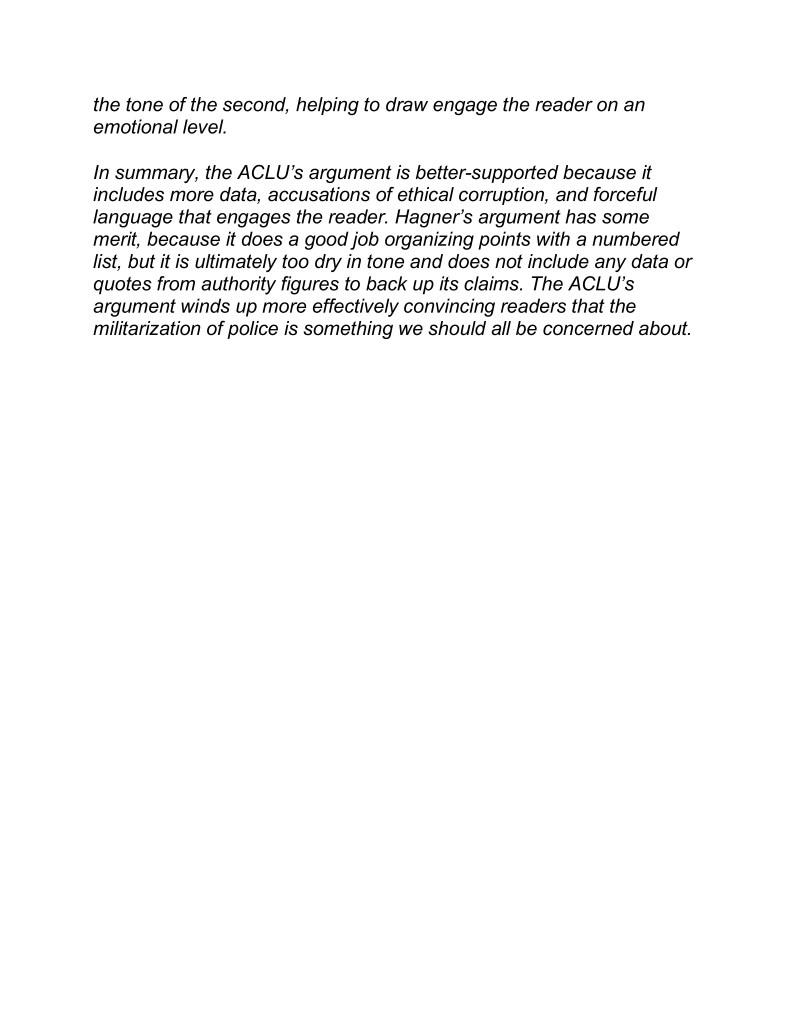
This essay is very well-organized. It uses 5 paragraphs and lays out the structure in the following manner:
- Paragraph 1 — Introduction (why the ACLU position is better-supported)
- Paragraph 2 — Reason #1 — Statistics (two examples given from passage)
- Paragraph 3 — Reason #2 — Ethics (one example given from passage)
- Paragraph 4 — Reason #3 — Diction (two examples given from passage)
- Paragraph 5 — Conclusion
In the introduction, the author thoughtfully presents the topic of police militarization and explains why it is relevant in today’s society. Both arguments are introduced, and the thesis is clearly placed at the end of the paragraph so they are easy for the reader to find. The thesis clearly states which argument the author believes is better-supported, and the language is confident.
Each of the next three body paragraphs is well-organized, starting with transitional words or phrases and including at least one example that supports the thesis. The body paragraphs cite specific examples from the passage, and then explain how those examples support the overall argument. The author uses three different examples: statistics, ethics, and vocabulary, to prove why the ACLU’s argument is better-supported. These diverse examples show that the author understands what makes an argument weak or strong.
Finally, the concluding paragraph makes a minor concession to the opposing side, praising the numbered list that appears therein, before reiterating the thesis from the Introduction.
The essay avoids any grammar or spelling errors and the sentence structure is clear and varied with the appropriate usage of commas and other punctuation. Clear command of the English language is demonstrated. As a result, this essay would earn a perfect score.
 GED Program